EPA and DHA are the two omega-3s worth paying for, and here is the part that catches people out: the United States has no official recommended daily intake for either one. Per the NIH Office of Dietary Supplements, the Food and Nutrition Board set an Adequate Intake for ALA, the plant omega-3, at 1.1 to 1.6 grams a day for adults, and set nothing at all for EPA and DHA, because neither is classed as essential. What exists instead is a ceiling, a food target, and a Supplement Facts panel most shoppers never read.
What is the difference between EPA and DHA?
EPA and DHA are both long-chain omega-3s from marine sources, and the real difference is where they end up in your body. DHA is structural. The NIH Office of Dietary Supplements describes DHA as present in large amounts in the brain and the retina, sitting inside cell membranes and making up a major part of the photoreceptor segments that let your eyes handle light. EPA is barely present in brain and nerve tissue at all. It concentrates in blood components and the retinal vascular lining, and its best-described property is anti-inflammatory.
So the shorthand is: DHA builds, EPA calms. Hold it loosely, because the two travel together in every fish that swims. It matters at the checkout because ratios differ wildly between products, and a bottle heavy on one is a different purchase than a bottle heavy on the other.
Do flaxseed and walnuts count as omega-3s?
ALA from flaxseed, chia and walnuts counts as an omega-3, but it is a poor substitute for EPA and DHA because your body converts very little of it. The NIH Office of Dietary Supplements puts conversion of dietary ALA into EPA at under 10 percent and into DHA at under 4 percent, and concludes that food and supplements are the only practical way to raise those levels. Worth sitting with if you have been grinding flax into a smoothie on the theory that it replaces fish. It does not. ALA is genuinely essential, but it is not a delivery route for DHA.
EPA vs DHA at a glance
| EPA | DHA | |
|---|---|---|
| Full name | Eicosapentaenoic acid | Docosahexaenoic acid |
| Where it concentrates | Blood components, retinal vascular lining | Brain and retina, inside cell membranes |
| Main described role | Anti-inflammatory | Structural, including photoreceptor membranes |
| Made from ALA? | Under 10% of dietary ALA (NIH ODS) | Under 4% of dietary ALA (NIH ODS) |
| Official US daily intake | None set | None set |
| Typical source | Oily fish, fish oil, krill oil | Oily fish, fish oil, krill oil, algal oil |
How much EPA and DHA should you take a day?
The clearest number the US government gives for EPA and DHA is a ceiling, not a target: the FDA recommends no more than 3 grams a day of EPA and DHA combined, including no more than 2 grams from supplements. That inverts how most people shop. You are not chasing a minimum. You are staying under a maximum.
For the target, the American Heart Association points at food and recommends two servings of fish a week, with an emphasis on the oily ones: salmon, mackerel, herring, lake trout, sardines, albacore tuna. That is roughly 6 ounces cooked. Hit it most weeks and a supplement is a top-up. Never eat fish, and the bottle is doing the whole job, which makes the back panel matter far more.
How do you read a fish oil label?
The big number on the front of a fish oil bottle is the weight of the oil, not the omega-3 inside it, and that one gap explains most disappointing purchases. A softgel marked 1000 mg is 1000 mg of oil. The EPA and DHA in it might be 300 mg or 800 mg, and only the Supplement Facts panel tells you.
- Add the EPA and DHA lines, ignore the rest. “Total omega-3s” can include fatty acids that are not doing the same job.
- Check the serving size. A panel that reads “Serving size: 2 softgels” quietly halves the value you just calculated.
- Compare cost per gram of EPA plus DHA. Not per bottle, not per capsule. It is the only comparison that survives across brands.
- Note the ratio before you commit to four months of it, and look for a third-party purity seal, since oxidized fish oil is the most common reason people quit.
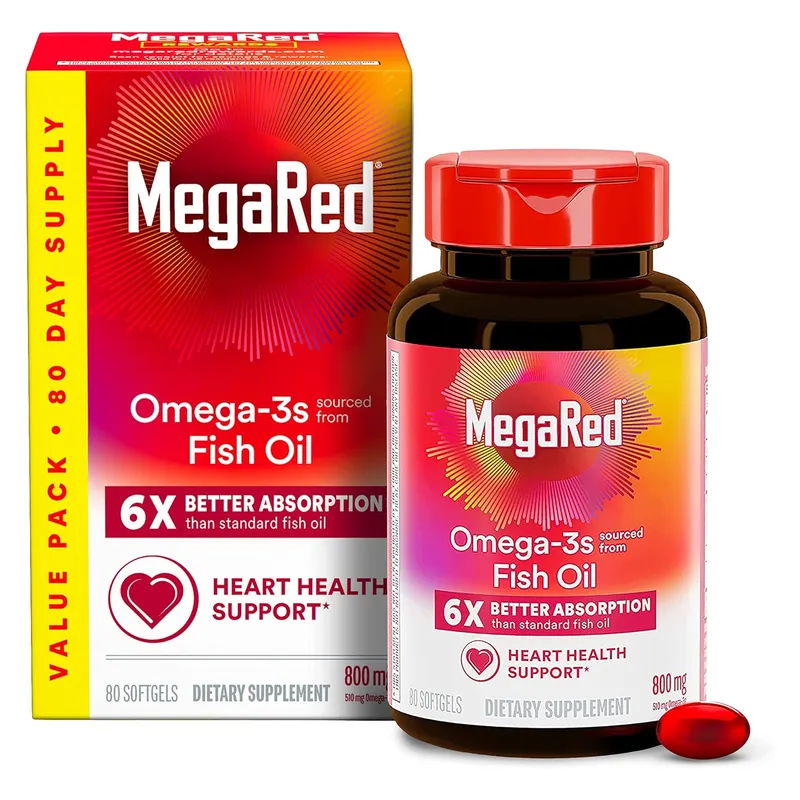
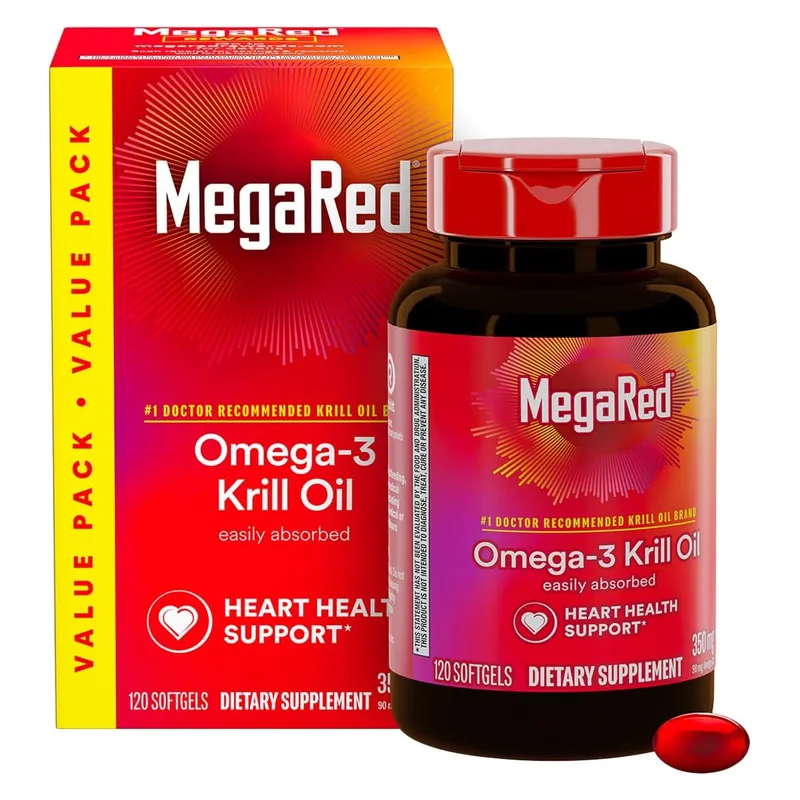
You can compare panels on the omega-3 softgels and krill oil in our joint health and memory and brain support sections, including the MegaRed Omega-3 Fish Oil 80 softgels and the MegaRed Superior Krill Oil Extra Strength. Strengths vary within one brand, so read the panel on the bottle you actually buy.
Fish oil, krill oil, or algal oil?
Fish oil, krill oil and algal oil all deliver EPA and DHA, and the source matters less than the dose you actually get. Fish oil is the cheapest route to a large EPA plus DHA number. Krill oil carries its omega-3s in phospholipid form and manufacturers state this improves absorption, but the comparative human evidence is not settled enough for us to call it worth a premium. Algal oil is the genuinely distinct option: DHA made by the algae that fish get theirs from, which makes it the practical choice if you avoid fish or animal products. A softgel you can keep down beats a theoretically superior one you abandon in week three.
Who should talk to a doctor first?
Omega-3 supplements carry real cautions at high doses, and two groups should check before starting. If you take warfarin or another anticoagulant, the NIH Office of Dietary Supplements notes that high doses of omega-3s may cause bleeding problems, so that is a conversation for your prescriber. The second flag is cardiac: the STRENGTH trial, which gave high-risk patients 4 grams a day, was stopped early after the supplemented group showed a higher incidence of atrial fibrillation. Evidence here stays mixed, which is exactly why gram-level doses are a medical decision. Pregnant, nursing, or buying for a child? Ask a clinician for a number instead of guessing from a label. Stacking several products already? Our guide to what should not be taken together is a useful cross-check.
Frequently asked questions
If I can only pick one, should it be EPA or DHA?
Most shoppers do not have to pick, since nearly every fish oil and krill oil contains both. The exception is algal oil, which is often DHA-dominant and is the standard route for people who avoid fish. The NIH Office of Dietary Supplements sets no intake recommendation for either, so there is no official basis for favouring one, and a balanced formula is a reasonable default.
Do I still need a supplement if I eat salmon twice a week?
Probably not. Two servings of oily fish a week is the American Heart Association’s own recommendation, so if you hit it consistently you are already doing what the supplement imitates. People who rarely eat fish are the ones for whom a capsule changes the arithmetic.
Is more always better with omega-3s?
No. The FDA recommends staying under 3 grams a day of EPA and DHA combined, with no more than 2 grams from supplements, and the high-dose STRENGTH trial was halted early over an atrial fibrillation signal. Doses in that range are a decision to make with a doctor, not a bottle to double on your own.
Is prescription omega-3 the same as a drugstore bottle?
No. Prescription omega-3 products are regulated as drugs, come in fixed high doses, and are prescribed for specific conditions such as very high triglycerides. An over-the-counter softgel is a dietary supplement and is regulated differently, so it is not a substitute if a doctor has prescribed one.
Related reading
- Magnesium Glycinate vs Citrate: Which One and When
- Best Time to Take Vitamin D and Why It Matters
- Collagen Supplements: What the Evidence Actually Says
This guide is general information, not medical advice. Talk to your doctor or pharmacist before starting an omega-3 supplement, especially if you take anticoagulants, have a heart rhythm condition, or are pregnant or nursing.