Collagen supplements have decent evidence for achy knees and surprisingly shaky evidence for wrinkles, which is roughly the opposite of how they are marketed. That is the short version. The longer version matters, because a tub of collagen peptides is not cheap and you deserve to know what you are paying for.

What is collagen, and what happens when you swallow it?
Collagen is the most abundant protein in your body, and a collagen supplement gets digested like any other protein. The Harvard T.H. Chan School of Public Health describes collagen as the fiber-like protein that builds connective tissue in bones, skin, muscles, tendons and cartilage. When you eat it, Harvard notes, it is broken down into amino acids that go wherever your body needs protein most.
That last point is the whole debate in one sentence. Your gut does not deliver a scoop of collagen peptides straight to your cheekbones. Supplement makers argue that certain peptide fragments survive digestion and nudge your own collagen production. Skeptics say you are mostly buying expensive glycine and proline. The trials are where this gets settled, so let’s look at them.
Do collagen supplements improve skin and wrinkles?
Collagen supplements for skin look effective until you sort the studies by who paid for them. A 2025 systematic review and meta-analysis in The American Journal of Medicine by Seung-Kwon Myung and Yunseo Park pooled 23 randomized controlled trials with 1,474 participants. Taken all together, collagen appeared to improve skin hydration, elasticity and wrinkles.
Then the authors split the trials by funding. Studies without pharmaceutical or industry funding showed no effect on hydration, elasticity or wrinkles. So did the high-quality trials without that funding. The authors, who declared no funding and no conflicts of interest, concluded there is no confirmed clinical benefit for skin aging.
Harvard’s Nutrition Source raises the same flag from another angle: most, if not all, collagen research is funded at least partly by related industries. Cleveland Clinic dermatologists have said the small studies showing better skin texture were manufacturer-sponsored. None of this proves collagen does nothing for skin. It means the glowing “clinically proven” line on the label deserves a raised eyebrow.
If skin is your main goal, my honest take is to get daily sunscreen right before you buy any powder. Browse our skin, hair and nails section for topical options, and ask a dermatologist before spending on an oral product.
Do collagen supplements help joint pain?
Collagen supplements have their strongest evidence for osteoarthritis, although the benefit is modest. A 2024 trial sequential meta-analysis in Osteoarthritis and Cartilage (Liang and colleagues, Taipei Medical University) included 35 randomized trials with 3,165 patients. Its main pain analysis covered 25 trials and 2,856 patients.
The result: small-to-moderate improvements in pain (rated moderate certainty) and in physical function (rated high certainty) compared with control groups. Collagen derivatives did not raise the risk of side effects or dropouts. The authors called the evidence strong. Harvard likewise notes that studies suggest collagen can improve joint mobility and reduce pain in people with osteoarthritis and in athletes.
“Small-to-moderate” is the honest phrase here. Think of collagen as a possible helper for stiff knees, not a replacement for exercise, weight management or the treatment plan your doctor gives you.
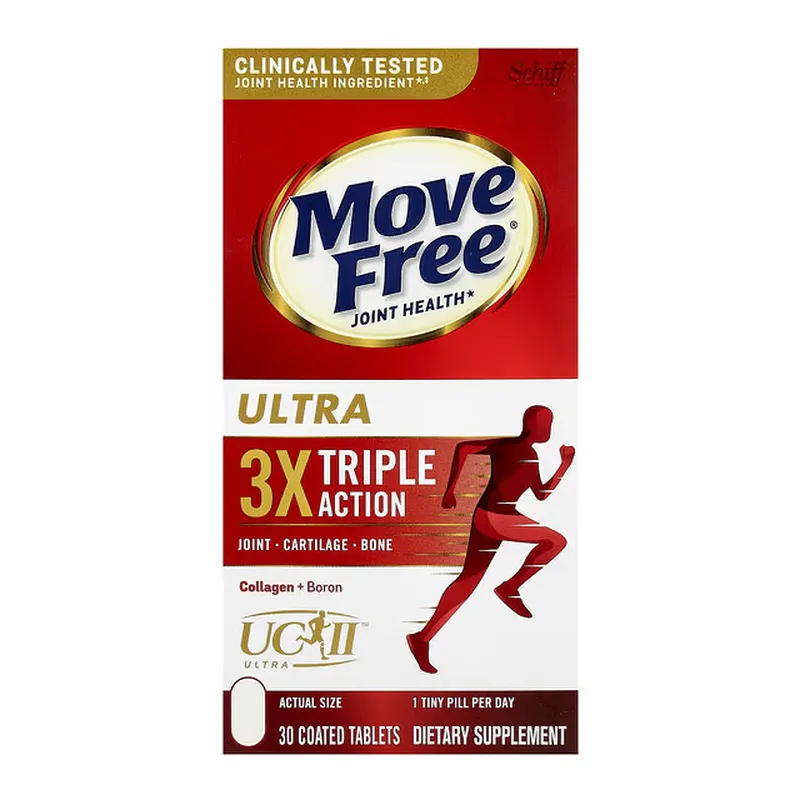
One practical detail most shoppers miss: joint products usually use a different form of collagen than beauty powders. Move Free Ultra Triple Action is a one-tablet-a-day formula that, according to the manufacturer, pairs Type II collagen with boron and hyaluronic acid. That is a tiny daily dose compared with a scoop of peptides, and it works differently, so do not assume results from one form carry over to the other. You can compare other options in our joint health collection.
Collagen claims vs. the evidence
| Claim you will see | What the evidence shows | Source |
|---|---|---|
| Fewer wrinkles, firmer skin | No effect in trials without industry funding | American Journal of Medicine, 2025 meta-analysis |
| Less joint pain | Small-to-moderate benefit in osteoarthritis | Osteoarthritis and Cartilage, 2024 meta-analysis |
| Complete protein source | No, collagen lacks the essential amino acid tryptophan | Nutrients journal, 2019 |
| Safe for daily use | Research reviewed has not shown negative side effects | Harvard T.H. Chan School of Public Health |
| Checked by the FDA | The FDA does not review supplements for safety or effectiveness before sale | Harvard T.H. Chan School of Public Health |
Is collagen a good protein source?
Collagen is a poor stand-in for your regular protein because it is incomplete. A 2019 paper in the journal Nutrients (Paul and colleagues) explains that collagen protein completely lacks tryptophan, one of the essential amino acids your body cannot make, so standard protein scoring classes it as an incomplete protein. So a collagen scoop in your coffee does not count the same as eggs, fish or a complete protein powder. If muscle is your goal, our guide to supplements that support protein synthesis covers better-studied choices.
Is collagen safe, and who should talk to a doctor first?
Collagen appears to be well tolerated in the research so far. Harvard reports that the studies it reviewed did not show negative side effects. Cleveland Clinic says collagen peptide doses between 2.5 and 15 grams a day are generally considered safe, and the 2024 osteoarthritis meta-analysis found no rise in side effects compared with control groups.
Two caveats. First, supplements are not FDA-approved before they hit shelves, so choose brands that use third-party testing. Second, collagen is made from animal tissue, so check the label for the source. Marine collagen comes from fish, which matters if you have a fish allergy. Talk to your doctor before starting if you are pregnant, have kidney disease, take several medications, or are managing arthritis under a doctor’s care. Our list of supplements that should not be taken together is a useful checklist before you add something new.
So, should you buy collagen?
Collagen makes the most sense if you have stiff, achy joints and want to try something low-risk for a few months. For skin, the independent evidence is not there yet, and I would put that money toward a good sunscreen first. Give any joint supplement about three months, track how you feel, and stop if nothing changes.
Collagen FAQ
How long do collagen supplements take to work?
Collagen needs patience, so give it a fair personal test of about 8 to 12 weeks rather than judging it after a fortnight. If your joints feel no different by then, the product probably is not doing much for you.
Does collagen help hair and nails grow?
Collagen for hair and nails is mostly a marketing promise so far, since the independent reviews covered here looked at skin and joints, not hair. For thinning hair, topical minoxidil is the over-the-counter ingredient the FDA has approved for regrowth, and you can find it in our hair care range.
Is marine collagen better than bovine collagen?
No independent research reviewed here shows marine collagen beats bovine collagen for skin or joints. Choose by allergy, diet and price. Fish-based collagen is not suitable if you have a fish allergy.
Can I get collagen from food instead?
Yes, collagen occurs naturally in tough, connective-tissue cuts like brisket, pot roast and chuck steak, and in fish bones and skin, according to Harvard’s Nutrition Source. Harvard adds that fish, poultry, eggs, dairy, legumes and soy supply the amino acids your body uses to build collagen, while vitamin C and zinc play supporting roles.