By Clara Brandt, supplement and nutrition writer who reads the label and the NIH fact sheet before anything else; not a dietitian, so check a new supplement with your doctor first.
Brain Health · Buyer Guide
Does Prevagen Really Work?
Prevagen is one of the most heavily marketed brain health supplements in the US. This guide covers what the product claims, what the ingredients are, what the FTC case means, and what to weigh before you buy.

Quick answer: Does Prevagen really work?
Prevagen is marketed as a dietary supplement formulated to support brain health — not as a drug that treats or reverses memory loss. Results vary by individual, and no memory improvement is guaranteed. Advertising claims that Prevagen improves memory or is clinically proven to work have been scrutinized by the FTC and a federal court.
Whether you’re asking because you saw a TV ad, heard it from a family member, or are comparing brain supplements online, the short answer is: we don’t know definitively that it works the way its marketing implies. What we do know is laid out below.
Compare Prevagen formulas at WellBeUp →
What is Prevagen?
Prevagen is an over-the-counter dietary supplement made by Quincy Bioscience. Its primary active ingredient is apoaequorin, a protein originally derived from a species of jellyfish (Aequorea victoria). The commercial version used in Prevagen is produced through a microbial fermentation process, not harvested directly from jellyfish.
It also contains vitamin D (50 mcg) in all formulas. It is not a prescription drug, not an OTC medication, and not FDA-approved as a drug. As a dietary supplement, it is regulated under the Dietary Supplement Health and Education Act (DSHEA), which means it reaches market without pre-approval for safety or effectiveness.
Prevagen comes in four main formulas, each differing primarily in the amount of apoaequorin:
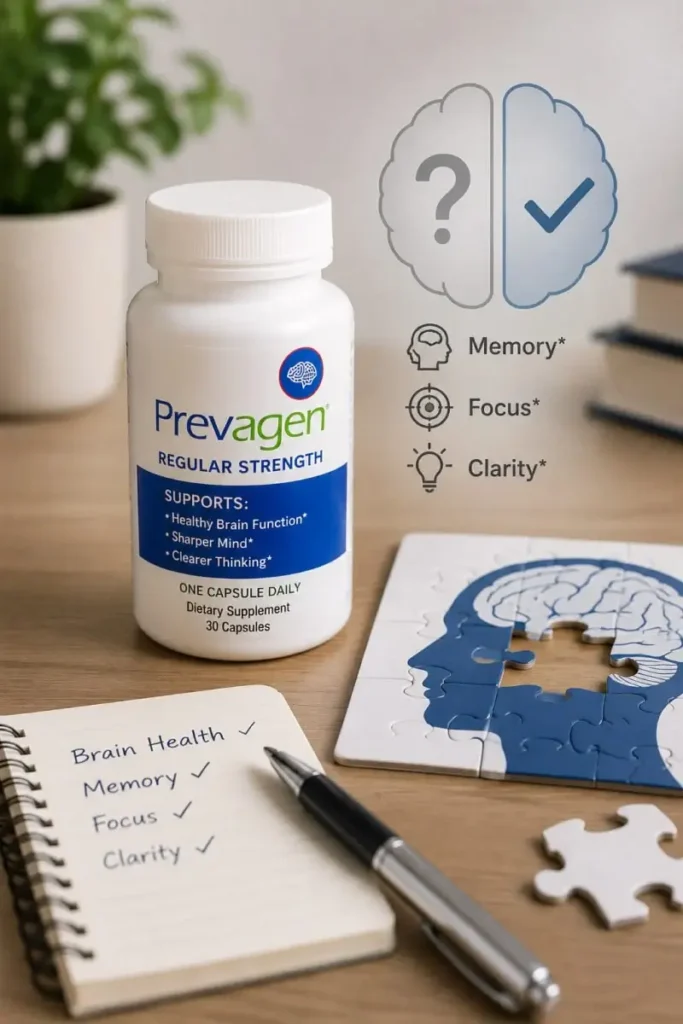
- Regular Strength — 10 mg apoaequorin, capsule, 30 count
- Extra Strength — 20 mg apoaequorin, capsule, 60 count
- Professional Formula — 40 mg apoaequorin, capsule, 30 count
- Extra Strength Chewables — 20 mg apoaequorin, chewable tablet, 30 count
See the Regular vs Extra Strength vs Professional Formula comparison table at the WellBeUp brand hub for a side-by-side breakdown of all four options.
What does Prevagen claim to do?
Prevagen is marketed as a supplement that “supports brain health” and is positioned in the memory and cognitive support category. The brand’s advertising has described the product as improving memory and supporting sharper thinking, clearer mind, and healthier brain function.
Under DSHEA, a supplement is permitted to make structure/function claims — statements that the product supports the structure or function of a body system — as long as the manufacturer notifies the FDA and includes the standard disclaimer:
“These statements have not been evaluated by the Food and Drug Administration. This product is not intended to diagnose, treat, cure, or prevent any disease.”
Claims that go further — specifically, that the product improves memory or has been clinically proven to do so — cross into territory that regulators and courts have contested. That distinction is at the center of the FTC case covered below.
What does the evidence say?
A 2016 peer-reviewed study (Moran et al.) published in the Advances in Mind-Body Medicine journal assessed apoaequorin in an adult population over 90 days. The study reported the compound was well-tolerated and suggested potential utility in some cognitive measures. Quincy Bioscience has used this study to support its advertising claims.
However, the study has limitations that matter for shoppers to understand:
- It was funded by the supplement’s manufacturer.
- The primary subgroup that showed differences was not the study’s pre-specified primary endpoint — a post-hoc finding that regulators consider weaker evidence.
- No large-scale, independent, placebo-controlled trial has replicated the results.
- A separate scientific question concerns whether orally ingested apoaequorin — a protein — survives digestion intact enough to cross the blood-brain barrier and reach brain tissue. Some researchers have raised this as a plausibility concern.
None of this makes Prevagen provably “fake,” but it does mean the evidence base for its advertised claims is contested. Shoppers should distinguish between a study exists and the claim is settled science.
FTC case: what buyers should know
In December 2024, a federal court ruled in favor of the FTC and the New York Attorney General in a long-running case against Quincy Bioscience, Prevagen’s maker. The court ordered the company to cease making claims that mislead Americans concerned about memory loss and found that health claims must be supported by reliable scientific evidence.
The FTC charged that the company made false or unsubstantiated claims that Prevagen:
- Improves memory
- Provides cognitive benefits including clearer thinking and sharper mind
- Is clinically shown to work
Approach TV or digital ads that claim Prevagen “improves memory” with extra caution. The court found that specific advertising language exceeded what the available evidence supports.
This does not mean Prevagen is illegal to sell or buy. Dietary supplements are legal products. It means certain specific advertising claims made by the manufacturer were found to be misleading by a federal court. You can read the full FTC statement and case record:
What ingredients are in Prevagen?
Prevagen’s formula is straightforward. Two active ingredients appear across all SKUs:
Vitamin D 50 mcg
| Ingredient | Amount (varies by formula) | What shoppers should know |
|---|---|---|
| Apoaequorin | 10 mg (Regular) · 20 mg (Extra Strength / Chewable) · 40 mg (Professional) | Calcium-binding protein from jellyfish; produced via microbial fermentation for the supplement. Whether ingested apoaequorin crosses the blood-brain barrier is a debated scientific question. |
| Vitamin D | 50 mcg (2,000 IU) — all formulas | Well-studied nutrient; 50 mcg is within commonly used supplementation ranges. Vitamin D deficiency is associated with cognitive health, though supplementation alone does not guarantee cognitive benefit. |
Inactive ingredients — fillers, coatings, and carriers — vary by SKU and formula type (capsule vs. chewable). Check the product label or the official Prevagen FAQ for the full ingredient list on each specific product. For a deeper breakdown, see our Prevagen ingredients guide.
How long does Prevagen take to work?
No specific timeline or result is guaranteed. The company’s website and advertising have referenced a 90-day study period, which some users take as an informal benchmark for evaluating the supplement. That said, the clinical evidence underpinning those timelines is contested (see the FTC section above).
If you’re considering Prevagen, it’s reasonable to evaluate it over several weeks as part of a consistent daily routine — but with realistic expectations that individual responses vary considerably. More importantly: if you’re experiencing meaningful memory changes, those concerns belong with a healthcare professional, not with a dietary supplement.
Prevagen is not a substitute for medical evaluation. A doctor can rule out underlying causes of cognitive change that a supplement cannot address.
Compare formulas on the WellBeUp Prevagen hub →
Prevagen side effects and safety
Prevagen has been on the market since 2007 and has a broad user base. For most healthy adults, it appears to be generally tolerated. That said, some users have reported adverse effects. Commonly noted ones include:
- Nausea
- Headache
- Dizziness
These are not guaranteed to occur and are not unique to Prevagen — they appear in reports for many supplements. If you experience any adverse effects, stop taking the product and speak with a healthcare professional.
Pregnant or nursing · Under 18 · Taking prescription or OTC medications · Managing a diagnosed health condition · Experiencing concerning or sudden changes in memory
Prevagen has not been evaluated for drug interactions in the same way a pharmaceutical would be. If you take any medications, confirm with your pharmacist or doctor before adding Prevagen to your routine. For a full look at reported effects, see our Prevagen side effects guide.
Regular vs Extra Strength vs Professional Formula
The four Prevagen formulas differ primarily in apoaequorin dose and format. A higher dose does not guarantee a stronger result — the relationship between dose and effect has not been established in independent trials. Choose based on format preference and personal consultation, not on the assumption that more milligrams means more benefit.
| Formula | Apoaequorin | Vitamin D | Format | Count | Best fit |
|---|---|---|---|---|---|
| Regular Strength | 10 mg | 50 mcg | Capsule | 30 | Starting point for new users; lowest apoaequorin dose |
| Extra Strength | 20 mg | 50 mcg | Capsule | 60 | Higher dose; larger count per bottle; most widely stocked option |
| Professional Formula | 40 mg | 50 mcg | Capsule | 30 | Maximum apoaequorin dose available; consult a professional before use |
| Extra Strength Chewables | 20 mg | 50 mcg | Chewable tablet | 30 | Same dose as Extra Strength; alternative for those who prefer not to swallow capsules |
View current prices on individual product pages at WellBeUp’s Prevagen brand hub. No prices are estimated here; supplement pricing changes regularly. For pricing context across retailers, see our Prevagen cost breakdown guide.
Prevagen vs Neuriva: should you compare them?
Prevagen and Neuriva are two of the most heavily advertised brain health supplements in the US. They are often compared directly because they compete for the same buyer — but they work from completely different ingredient premises:
| Feature | Prevagen | Neuriva |
|---|---|---|
| Active ingredient | Apoaequorin (jellyfish-derived protein) | Phosphatidylserine + coffee fruit extract |
| Plus | Vitamin D (50 mcg) | B vitamins (varies by product) |
| Regulatory history | FTC court order (Dec 2024) on advertising claims | Separate FTC scrutiny of memory-related claims |
| Format options | Capsule, chewable | Capsule, gummies |
Neither product has been shown in large-scale independent trials to definitively improve memory in healthy adults. Deciding between them depends on ingredient preference, cost, format, and what your doctor recommends — not on which brand has more compelling TV commercials. For a full side-by-side, see our Prevagen vs Neuriva comparison guide.
Is Prevagen worth buying?
That depends on what you’re expecting from it — and that’s not a dodge. Here’s a fair framing:
Worth considering if: you want to add a daily brain health supplement to an existing wellness routine, you’ve discussed it with a healthcare provider, you understand that it’s not a drug, and you have realistic expectations that results vary and are not guaranteed. Some people find value in it as part of a broader healthy lifestyle.
Not a substitute for: medical evaluation of memory concerns. If you or a family member are experiencing meaningful cognitive changes, those should be evaluated by a doctor — not managed with an OTC supplement. The FTC case is a reminder that advertising language for these products can overstate what the evidence supports.
On pricing: Prevagen is not inexpensive relative to other supplements. Check individual product pages on WellBeUp for current prices, and compare per-serving cost across formula options. Larger-count bottles (like the Extra Strength 60-count) often offer a better cost-per-serving than the 30-count options. See our Prevagen cost breakdown for more detail.
If you’re ready to compare formulas and pricing, the WellBeUp Prevagen brand hub has all four SKUs in one place, with direct links to each product page.
Compare all four Prevagen formulas — Regular, Extra Strength, Professional, and Chewables — with current pricing on each product page.
Sources
- FTC. “Statement on FTC’s Win in Lawsuit Against Makers of Dietary Supplement Prevagen.” December 2024.
- FTC. Case record: Quincy Bioscience Holding Company.
- FDA. Structure/Function Claims.
- Moran DL, et al. “Apoaequorin protects against NMDA excitotoxicity.” Advances in Mind-Body Medicine. 2016.
- Prevagen. Official FAQ — ingredient amounts by formula.
Prevagen FAQ