By Clara Brandt, supplement and nutrition writer who reads the label and the NIH fact sheet before anything else; not a dietitian, so check a new supplement with your doctor first.
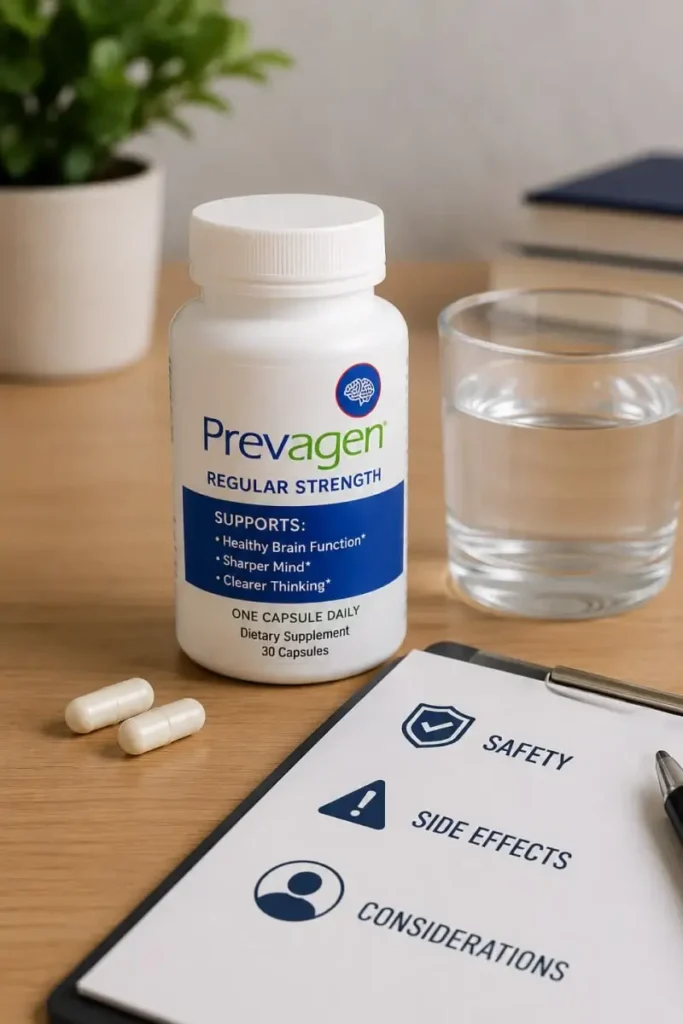
Prevagen Side Effects & Safety: What to Know Before Taking It
What reported side effects are associated with Prevagen? Is it safe for everyone? This guide covers adverse event reports, who should ask a doctor first, FDA regulatory status, and the FTC legal context — so you can make an informed decision.

Quick answer: What are the side effects of Prevagen?
Reported adverse events associated with Prevagen include headache, nausea, constipation, dizziness, edema (swelling), and elevated blood pressure. These are reports — they do not prove that Prevagen caused these symptoms. If you experience any adverse effect while taking Prevagen, stop use and consult a healthcare professional. Prevagen is not safe for everyone; individual risk depends on health status, medications, and other factors.
This guide is an informational resource, not medical advice. It summarizes publicly available information about reported side effects, FDA regulatory status, and safety considerations for Prevagen. It is not a substitute for guidance from a licensed healthcare professional.
Compare all Prevagen formulas at WellBeUp →
What is Prevagen?
Prevagen is an over-the-counter dietary supplement manufactured by Quincy Bioscience. It is not a prescription drug or an FDA-approved medication. Its two key listed ingredients are apoaequorin (a calcium-binding protein originally identified in jellyfish but now produced through recombinant manufacturing) and vitamin D (50 mcg / 2,000 IU per serving).
Prevagen is formulated to support brain health and is marketed primarily to adults concerned about memory and cognitive function. It comes in four formulas: Regular Strength (10 mg apoaequorin), Extra Strength (20 mg), Professional Formula (40 mg), and Extra Strength Chewables (20 mg). Apoaequorin dose is the key differentiator between formulas; vitamin D remains the same across all four.
Because Prevagen is a dietary supplement, it is subject to different regulatory rules than pharmaceutical drugs. These differences matter when evaluating both efficacy claims and safety — a point covered in more detail in the FDA status section below. For a deeper look at what’s in each formula, see the Prevagen ingredients guide.
Reported Prevagen side effects
Prevagen is a dietary supplement, and dietary supplements are not required to undergo the same pre-market safety and efficacy trials as pharmaceutical drugs. Adverse event reporting for supplements is largely voluntary. The table below summarizes effects that have appeared in adverse event reports, including those documented by NCBI Bookshelf (LiverTox) in their review of apoaequorin. These are reported effects — they do not establish that Prevagen was the cause.
| Reported issue | What it may feel like | What to do | Notes |
|---|---|---|---|
| Headache | Tension or throbbing pain in the head | Stop use; consult a healthcare professional if persistent | Among the more frequently mentioned reports in adverse event summaries |
| Nausea | Unsettled stomach, queasiness | Try taking with food; consult a healthcare professional if it continues | Reported to the manufacturer and noted in NCBI/LiverTox review |
| Constipation | Infrequent or difficult bowel movements | Stay hydrated; consult a healthcare professional | Listed in adverse event reports; does not prove causation |
| Dizziness | Lightheadedness, unsteadiness, feeling off-balance | Sit or lie down; stop use and consult a doctor, especially if severe | Of particular concern for older adults who may already have balance issues |
| Edema (swelling) | Swelling in hands, feet, legs, or ankles | Stop use; consult a healthcare professional promptly | Reported in adverse event summaries; warrants medical evaluation |
| Elevated blood pressure / hypertension | Often symptomless; detected by measurement | Stop use; consult a healthcare professional — especially if on blood pressure medications | Appeared in adverse event reports; causation not established |
Is Prevagen safe to take?
Prevagen is not safe for everyone, and it would be inaccurate to characterize it that way. Whether it is appropriate for any specific individual depends on their health history, current medications, age, pregnancy or nursing status, and other supplements they may be taking.
NCBI Bookshelf’s review of apoaequorin notes that serious adverse events have been reported anecdotally, though a direct causal link has not been established. The FDA does not pre-approve dietary supplements for safety, meaning that the pre-market safety vetting applied to pharmaceutical drugs does not apply here. Supplement manufacturers are responsible for ensuring their products are safe before marketing them, but this is a different — and generally lower — bar than drug approval.
For many healthy adults who are not on medications and do not have relevant conditions, Prevagen may be tolerated without issue. But “tolerated by many” is different from “safe for everyone.” If you are uncertain whether Prevagen is appropriate for your situation, the right first step is to ask your doctor or pharmacist.
Who should not take Prevagen or should ask a doctor first?
The following groups should consult a healthcare professional before starting Prevagen. This is not an exhaustive medical list — it covers the categories most likely to carry elevated risk or where interactions are plausible but unstudied.
- Pregnant or planning to become pregnant
- Currently nursing or breastfeeding
- Under 18 years of age
- Taking any prescription medication
- Taking OTC medications regularly
- Taking other vitamin D supplements
- Diagnosed with a cardiovascular condition
- Diagnosed with high blood pressure
- Diagnosed with a kidney or liver condition
- Diagnosed with a neurological condition
- Experiencing new or worsening memory changes
- Managing any other diagnosed health condition
This list is about adding a precautionary step, not necessarily a prohibition. In many of these cases, a clinician or pharmacist will be able to quickly assess whether there is a meaningful concern. What matters is that the conversation happens before you start the supplement, not after a problem arises.
Prevagen drug interactions and medications
Unlike pharmaceutical drugs, dietary supplements are not required to undergo systematic drug interaction studies before going to market. This means there is no exhaustive, peer-reviewed interaction database for Prevagen comparable to what exists for prescription medications.
This absence of documented interactions is not the same as an absence of risk. It means the interactions simply have not been formally studied. Anyone taking prescription medications — for heart disease, blood pressure, blood thinners, neurological conditions, kidney or liver conditions, or anything else — should ask a doctor or pharmacist before adding any dietary supplement to their routine, including Prevagen.
One interaction worth flagging specifically: Prevagen includes 50 mcg (2,000 IU) of vitamin D in every formula. If you are already taking a vitamin D supplement separately, combining the two adds to your total daily vitamin D intake. While 2,000 IU alone is within common ranges, accumulating high doses of vitamin D from multiple sources can lead to toxicity over time. Review your total intake with a healthcare provider.
Liver, kidney and blood pressure concerns
These three specific areas generate a notable volume of search queries around Prevagen, so it is worth addressing each directly.
Liver concerns
NCBI Bookshelf’s LiverTox database, which tracks dietary supplement-associated liver injury, does not identify a clear hepatotoxicity (liver injury) signal for apoaequorin specifically. That said, the LiverTox entry does document adverse events reported to the manufacturer, including the types of effects listed in the side effects table above. The absence of a confirmed liver injury signal does not mean the liver is completely unaffected in all users, particularly those who already have liver conditions or take medications that are processed by the liver. Anyone with diagnosed liver disease should consult a clinician before taking Prevagen.
Kidney concerns
There is no specific published signal linking Prevagen to acute kidney injury. However, people with pre-existing kidney disease are in a category that warrants caution with most dietary supplements, because the kidneys play a key role in processing and excreting compounds. Vitamin D, in particular, requires careful dosing in individuals with kidney conditions — and Prevagen includes 50 mcg per serving. A nephrologist or primary care physician is the right person to advise on supplement safety for anyone managing kidney disease.
Blood pressure concerns
Hypertension has appeared in adverse event reports associated with Prevagen. These reports do not prove that Prevagen caused elevated blood pressure in those individuals — they may have had pre-existing hypertension or other contributing factors. Nevertheless, anyone with high blood pressure or a cardiovascular condition should raise this with a clinician before starting Prevagen, particularly if they are on blood pressure medications.
Is Prevagen FDA approved?
No. Prevagen is not FDA approved. It is a dietary supplement regulated under a framework that does not require pre-market approval of the product’s safety or efficacy. Under the Dietary Supplement Health and Education Act of 1994 (DSHEA), dietary supplement manufacturers are responsible for ensuring their products are safe before they reach the market, but they are not required to submit safety data to the FDA for review before selling.
This is a fundamentally different standard from what applies to pharmaceutical drugs, which must demonstrate safety and efficacy in clinical trials before the FDA approves them. A dietary supplement being legally sold does not imply FDA approval of its safety or effectiveness.
The FDA can take action against dietary supplements after they are on the market if evidence of harm emerges, but pre-market review does not occur. Prevagen is required to carry the following disclaimer on its label, per FDA regulations:
This disclaimer applies to all structure/function claims made about dietary supplements — including any claims about brain health support. It means that such claims have not been reviewed or verified by the FDA as a condition of sale.
FTC case and safety claims: what it does and does not mean
In a case brought by the Federal Trade Commission and the New York Attorney General, the FTC charged Quincy Bioscience — Prevagen’s manufacturer — with making false and unsubstantiated advertising claims that Prevagen improves memory, provides cognitive benefits, and is clinically shown to work. In December 2024, the FTC announced that a court had ordered the makers of Prevagen to cease misleading claims related to memory loss.
It is important to understand what this legal outcome does and does not mean from a safety perspective. The FTC case centered on advertising claims about efficacy — whether the marketing accurately represented what the product does. It did not conclude that Prevagen is illegal, that it contains harmful ingredients, or that the company committed fraud with respect to its ingredient composition.
What the case does reinforce is the importance of applying skepticism to marketing claims. If advertising stated that Prevagen “improves memory” in a way that implied clinical proof, a court found that claim was not substantiated. That context is relevant when evaluating how to weigh what you read on packaging or promotional materials. For a fuller discussion of the evidence question, see Does Prevagen Really Work?
What to do if you have side effects
If you are taking Prevagen and develop symptoms you believe may be related to the supplement, follow these steps:
- Stop taking Prevagen immediately. Do not continue use while experiencing symptoms that concern you.
- Save the bottle and label. Your healthcare provider may need the product name, lot number, dose, and ingredient panel. Photograph the label as a backup.
- Contact a healthcare professional. Describe your symptoms, when they started, the dose you were taking, and any other medications or supplements you are on. Your doctor or pharmacist can advise on next steps.
- Seek emergency care immediately if symptoms are severe. Symptoms such as chest pain, difficulty breathing, severe swelling, sudden vision changes, or signs of allergic reaction require emergency medical attention — do not wait for a regular appointment.
- Consider reporting to FDA MedWatch for serious adverse events. MedWatch is the FDA’s safety reporting program for supplements and other products. Reports help regulators identify patterns that may not be visible from individual cases.
Prevagen formula comparison: 10 mg, 20 mg, 40 mg
Prevagen is available in four formulas. The primary difference between them is the dose of apoaequorin. All formulas include 50 mcg vitamin D. From a safety standpoint, a higher dose does not automatically mean a higher risk — but it also does not guarantee a stronger benefit. No dose–response relationship for apoaequorin in humans has been established in large independent trials.
| Formula | Apoaequorin | Vitamin D | Format | Count | Shop |
|---|---|---|---|---|---|
| Regular Strength | 10 mg | 50 mcg (2,000 IU) | Capsule | 30 | View |
| Extra Strength | 20 mg | 50 mcg (2,000 IU) | Capsule | 60 | View |
| Professional Formula | 40 mg | 50 mcg (2,000 IU) | Capsule | 30 | View |
| Extra Strength Chewables | 20 mg | 50 mcg (2,000 IU) | Chewable tablet | 30 | View |
If you are considering a higher-strength formula, discuss this with a healthcare professional before making the switch — particularly if you have any of the conditions listed in the “who should ask a doctor” section above. Higher dose does not mean faster or stronger results have been demonstrated.
Should you buy Prevagen if you are worried about side effects?
That depends on your situation, and the honest answer is that a healthcare professional is better positioned to advise you than any website. What this guide can offer is a framework for thinking about the decision.
If you are a healthy adult with no relevant conditions, not on medications, and have realistic expectations about what a dietary supplement can do, and you have discussed it with a doctor or pharmacist, then the choice is yours to make. The reported side effects are documented but, based on current public information, do not represent a widespread or definitive safety crisis for the general healthy adult population.
If you fall into any of the categories in the “who should ask a doctor first” section — pregnant, nursing, under 18, on medications, diagnosed conditions, or experiencing genuine memory changes — do not start Prevagen without medical guidance. Genuine memory concerns, in particular, should be evaluated medically rather than addressed with a supplement.
Price comparisons, formula guides, and shopping options are available at the WellBeUp Prevagen brand hub. For a cost-focused comparison, see the Prevagen cost breakdown. For a side-by-side comparison with Neuriva, see Prevagen vs Neuriva.
Ready to compare Prevagen formulas?
WellBeUp carries all four Prevagen formulas. Compare doses, formats, and counts — and check individual product pages for current pricing.
Shop Prevagen at WellBeUpSources
- Prevagen official FAQ — ingredient amounts: 10–40 mg apoaequorin and 50 mcg vitamin D; full ingredient panels by product.
- NCBI Bookshelf / LiverTox: Apoaequorin — apoaequorin safety context; adverse events reported to sponsor include headache, nausea, constipation, edema, hypertension; FDA approval status.
- FDA Structure/Function Claims — dietary supplement disclaimer and disease-claim boundaries.
- FDA Notifications for Structure/Function Claims — DSHEA disclaimer wording and notification requirements.
- eCFR 21 CFR 101.93 — disclaimer placement and language for supplement labeling.
- FTC case record: Quincy Bioscience — legal context for claims that Prevagen improves memory and is clinically shown to work.
- FTC statement, December 2024 — court order context for misleading claims about memory loss.
- FDA MedWatch — reporting serious adverse events related to supplements and other products.