By Clara Brandt, supplement and nutrition writer who reads the label and the NIH fact sheet before anything else; not a dietitian, so check a new supplement with your doctor first.
Ingredients Guide
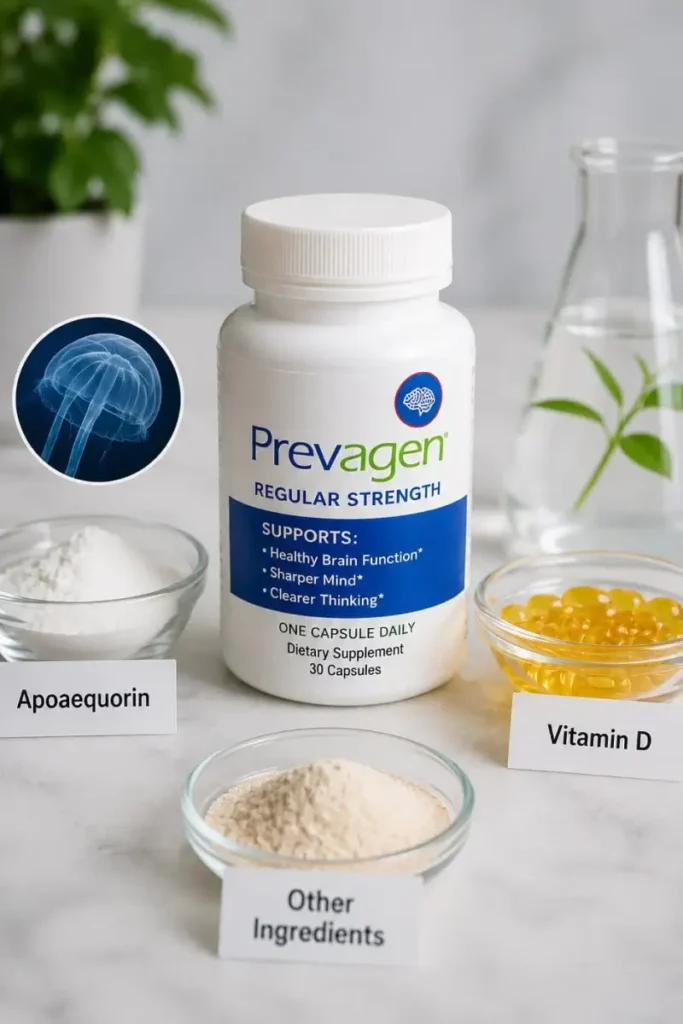
Prevagen Ingredients: Apoaequorin, Vitamin D & What’s Inside Each Formula
What is actually in Prevagen? This guide covers both key listed ingredients across all formulas, how doses differ by SKU, what apoaequorin is and where it comes from, and what to check before buying.

Quick answer: What are the ingredients in Prevagen?
Every Prevagen formula lists two key ingredients: apoaequorin (10–40 mg depending on formula) and vitamin D (50 mcg / 2,000 IU). Inactive ingredients — capsule shells, coatings, flow agents — vary by SKU and are not standardized across all products. Always verify the Supplement Facts panel on the specific product you are purchasing.
These two ingredients are consistent across the brand’s lineup. The dose of apoaequorin is the primary variable that changes from one product tier to the next — Regular at 10 mg, Extra Strength and Chewables at 20 mg, Professional Formula at 40 mg. Vitamin D stays at 50 mcg across all formulas.
Compare all Prevagen formulas at WellBeUp →
Prevagen ingredient list by formula
The table below summarizes the key listed ingredients across all four Prevagen formulas available at WellBeUp. Inactive ingredients are not listed here because they differ between SKUs — capsule-format products and chewable tablets have different excipients. Check the product label or Prevagen’s official FAQ for the full ingredient panel of a specific SKU.
| Formula | Apoaequorin | Vitamin D | Format | Count |
|---|---|---|---|---|
| Regular Strength | 10 mg | 50 mcg (2,000 IU) | Capsule | 30 |
| Extra Strength | 20 mg | 50 mcg (2,000 IU) | Capsule | 60 |
| Professional Formula | 40 mg | 50 mcg (2,000 IU) | Capsule | 30 |
| Extra Strength Chewables | 20 mg | 50 mcg (2,000 IU) | Chewable tablet | 30 |
What is apoaequorin?
Apoaequorin is a calcium-binding protein. It was first identified in the 1960s by biochemists Osamu Shimomura and Frank Johnson, who isolated it from the bioluminescent jellyfish Aequorea victoria — the same research that eventually led to the discovery of green fluorescent protein (GFP) and a Nobel Prize in 2008.
In its natural form, apoaequorin binds calcium and, when combined with a compound called coelenterazine, produces a flash of blue light. In a marine environment, this serves a bioluminescence function. Inside the human body, the precise role and behavior of orally ingested apoaequorin is a more complicated question — one that has been the subject of both published research and regulatory debate.
Quincy Bioscience, Prevagen’s manufacturer, has described apoaequorin as supporting brain health through its calcium-binding properties. Some researchers and regulators have questioned whether a protein like apoaequorin, when taken orally, survives the digestive process intact enough to reach and influence brain tissue. This remains a debated scientific question — it is not accurate to say definitively that it does or does not cross relevant barriers to act in the brain.
Is Prevagen made from jellyfish?
This is one of the most common questions about Prevagen, and the answer requires a careful distinction: apoaequorin was originally discovered in jellyfish, but the apoaequorin used in Prevagen is not harvested from wild jellyfish.
Quincy Bioscience manufactures apoaequorin through a recombinant microbial fermentation process — the gene encoding the protein is expressed in bacteria, and the resulting protein is harvested and purified. This is the same general manufacturing approach used for many proteins and bioactive compounds in the supplement and pharmaceutical industry.
Apoaequorin was discovered in jellyfish. The protein in Prevagen is manufactured, not harvested from the ocean. If you have a seafood or shellfish allergy, check with your doctor and review the full Supplement Facts label — do not rely solely on the “jellyfish connection” to assess allergen risk.
How much apoaequorin is in each Prevagen formula?
Apoaequorin content is the main variable distinguishing the four Prevagen products. Here’s a quick reference:
A dose–response relationship for apoaequorin in humans has not been established in large independent trials. The Professional Formula contains the highest available dose, but that alone does not guarantee a proportionally stronger effect. If you’re considering the higher-dose options, discuss with a healthcare professional first.
Vitamin D in Prevagen: 50 mcg / 2,000 IU
All four Prevagen formulas include 50 mcg (2,000 IU) of vitamin D per serving. This is a meaningful inclusion because vitamin D is a well-studied nutrient involved in multiple body systems, and deficiency is common in the general adult population.
2,000 IU falls within the range many healthcare providers discuss for adult supplementation, though optimal dosing depends on individual factors including current blood levels, sun exposure, age, and body weight. The Tolerable Upper Intake Level (UL) set by the National Academy of Medicine is 4,000 IU per day for most adults — 2,000 IU is below that threshold.
What vitamin D does not do is specifically improve memory on its own, and Prevagen does not make that claim for the vitamin D component specifically. It is a supplemental nutrient that Quincy Bioscience includes alongside apoaequorin. If you are already taking a separate vitamin D supplement, check your total daily intake across all products with your healthcare provider to avoid unnecessarily high cumulative doses.
Inactive ingredients and Supplement Facts labels
Prevagen’s inactive ingredients — the excipients that give capsules or tablets their physical form — are not standardized across all SKUs. A capsule-format product and a chewable tablet will have different binding agents, coatings, and carrier substances. Examples of typical capsule excipients include cellulose, magnesium stearate, and silicon dioxide, though you should verify against the current label rather than rely on general assumptions.
For the most current full ingredient information on any specific Prevagen product:
- Read the physical Supplement Facts panel on the product packaging
- Check Prevagen’s official FAQ page for disclosed ingredient information by SKU
- Contact Quincy Bioscience directly if you have a specific allergen concern not addressed on the label
Supplement manufacturers periodically update formulas, packaging, and suppliers. Always read the current label on your specific purchased product — not an older label image found online — especially if you have allergies or intolerances.
Does Prevagen contain caffeine, shellfish, gluten, soy or common allergens?
The two key listed ingredients in Prevagen — apoaequorin and vitamin D — are not caffeine, gluten, soy, or shellfish. However, this page cannot confirm specific allergen claims such as “gluten-free,” “shellfish-free,” or “caffeine-free” because:
- Inactive ingredients vary by SKU and can change over time
- Manufacturing processes differ, and cross-contamination disclosures depend on current facility practices
- The jellyfish origin of apoaequorin sometimes prompts questions about shellfish cross-reactivity — this is a question for your allergist and the manufacturer, not a marketing page
| Allergen / substance | In key listed ingredients? | What to do |
|---|---|---|
| Caffeine | Not present in apoaequorin or vitamin D | Verify the current product label to confirm no caffeine-containing excipients are present in your specific SKU |
| Shellfish / seafood | Apoaequorin is not derived from shellfish; jellyfish are not crustaceans | If you have a shellfish allergy, consult your allergist and the manufacturer before use — do not assume safety |
| Gluten | Not present in apoaequorin or vitamin D | Confirm with the current product label and manufacturer if gluten-free certification is important to you |
| Soy | Not listed as a key ingredient | Verify inactive ingredients on the specific label; soy-derived excipients are possible in some supplement products |
For all allergen questions, the authoritative source is the product’s current Supplement Facts panel and, if needed, direct communication with Quincy Bioscience.
Prevagen ingredients vs Neuriva ingredients
Prevagen and Neuriva are two of the most searched brain health supplements on the market. Shoppers frequently compare them — but the two products share no key ingredients and use entirely different ingredient approaches.
| Feature | Prevagen | Neuriva |
|---|---|---|
| Key branded ingredient | Apoaequorin (jellyfish-derived protein, manufactured) | Phosphatidylserine (from sunflower lecithin) + Coffee Fruit Extract (Coffea arabica) |
| Plus | Vitamin D 50 mcg | B vitamins (B6, B12, folate — varies by formula) |
| Dose range | Apoaequorin 10–40 mg | Phosphatidylserine 100 mg (standard formula) |
| Format options | Capsule, chewable | Capsule, gummies |
| Regulatory history | FTC court order (Dec 2024) on advertising claims | Separate FTC scrutiny of memory-related advertising |
| Large independent trial evidence | Contested; no large-scale independent RCT | Contested; no large-scale independent RCT |
The ingredient difference matters for several reasons: if you have specific dietary restrictions, sensitivities, or preferences about which compounds you take, comparing the two labels side by side is more informative than comparing advertising claims. For a full side-by-side including format, price, and evidence context, see our Prevagen vs Neuriva comparison guide.
Ingredient safety notes before buying
Prevagen has been on the market since 2007 and is used by a large number of adults. For most healthy adults who are not taking medications and do not have underlying conditions, the ingredients at listed doses are generally tolerated. That said, dietary supplements are not pre-approved by the FDA, and individual responses vary.
Pregnant or nursing · Under 18 · Taking prescription or OTC medications · Managing a diagnosed health condition, especially cardiovascular or neurological · Already taking vitamin D supplements (check cumulative total)
Some users have reported nausea, headache, or dizziness while taking Prevagen. These are not guaranteed and may be incidental, but if you experience them, stop use and consult a healthcare professional. For more detail, see our Prevagen side effects guide.
One specific ingredient note: if you take other supplements that include vitamin D, be aware that Prevagen adds another 50 mcg (2,000 IU) per day. Chronic high-dose vitamin D supplementation above the tolerable upper limit can have adverse effects. Confirm your total daily intake with your doctor if you take multiple products containing vitamin D.
Should you buy Prevagen based on ingredients?
The ingredients in Prevagen — apoaequorin and vitamin D — are the honest answer to what you’re buying. They are not a proprietary blend obscuring what’s inside: the amounts are clearly labeled per formula. Whether those specific ingredients, at those doses, will produce a noticeable benefit for you is a different question — one that the available evidence does not answer definitively, and one the FTC found the manufacturer overstated in its advertising.
What the ingredient profile tells you concretely:
- You’re buying one novel proprietary ingredient (apoaequorin) and one well-understood nutrient (vitamin D)
- The dose of apoaequorin escalates across the product tier; vitamin D stays constant
- Neither ingredient appears on lists of known high-risk or heavily regulated compounds
- Inactive ingredients vary and should be verified on the specific product label
If the ingredient profile looks right for your situation and you’ve spoken with your healthcare provider, compare all four Prevagen formulas and current pricing at the WellBeUp Prevagen brand hub. For context on how Prevagen is positioned versus what evidence exists for those positions, read our Does Prevagen Really Work? guide.
Compare Regular, Extra Strength, Professional Formula, and Chewables — with current pricing on each product page.
Sources
- Prevagen. Official FAQ — ingredient amounts by formula.
- NCBI / NLM. LiverTox: Apoaequorin.
- Moran DL, et al. Apoaequorin study. Advances in Mind-Body Medicine. 2016.
- FDA. Structure/Function Claims.
- FTC. Statement on FTC’s Win Against Makers of Prevagen. December 2024.
Prevagen Ingredients FAQ