A Plain-English Guide to Probiotic Strains

By Clara Brandt, supplement and nutrition writer who reads the label and the NIH fact sheet before anything else; not a dietitian, so check a new supplement with your doctor first.
Probiotic strains are the third word on the label, and that third word is the only one that predicts what the capsule will do. Lactobacillus is a genus. Rhamnosus is a species. GG is a strain, and GG is the part with studies attached to it. Most people shop by the billions of CFU on the front and never read the strain list on the back. That is backwards. This guide fixes the reading order.
What does a probiotic strain actually mean on the label?
A probiotic strain is one specific, catalogued line of a bacterial or yeast species, identified by the letters and numbers after the species name, such as Lactobacillus rhamnosus GG or Bifidobacterium lactis Bl-04. The NIH Office of Dietary Supplements says a probiotic label should give you the genus, species and strain of each microorganism, plus the CFU count, the use-by date and storage instructions. Two strains of the same species can behave differently in your gut, so a study on one does not transfer to its cousins. A label that reads only “Lactobacillus acidophilus” with no code is selling you a species, not a studied strain. Not automatically bad. Just unverifiable.
Why did the names on your probiotic bottle change in 2020?
Lactobacillus was split into 25 genera in 2020, so one strain can now appear under two names depending on when the label was printed. The reclassification, published by Zheng and colleagues in the International Journal of Systematic and Evolutionary Microbiology, rests on whole-genome sequencing. Lactobacillus rhamnosus became Lacticaseibacillus rhamnosus, Lactobacillus plantarum became Lactiplantibacillus plantarum, and Lactobacillus acidophilus kept its name. The strain codes did not move. GG is still GG. Most US labels, including the ones in our gut and digestive health section, still print the old names. Same organism, new paperwork.
Which probiotic strains have real evidence behind them?
Saccharomyces boulardii and Lactobacillus rhamnosus GG are the two probiotics with the most consistent evidence, and nearly all of it concerns diarrhea, specifically the kind antibiotics cause. The NIH Office of Dietary Supplements states that LGG and S. boulardii might reduce the risk of antibiotic-associated diarrhea in people younger than 65, mostly when started within two days of the first antibiotic dose. The American Gastroenterological Association went further in its June 2020 guideline: for people on antibiotics, it suggests S. boulardii, or the pair of Lactobacillus acidophilus CL1285 with Lactobacillus casei LBC80R, or specific three- and four-strain combinations, to lower the risk of C. difficile infection.
Notice the shape of that. Named strains, one job, a time window. The same AGA guideline made no recommendation for irritable bowel syndrome, Crohn’s disease or ulcerative colitis outside clinical trials, so a bottle that promises to fix your IBS is ahead of the evidence.
Probiotic strain cheat sheet
| Strain on the label | What it is | Best-supported use, and who says so |
|---|---|---|
| Lactobacillus rhamnosus GG (LGG) | Bacterium, also written Lacticaseibacillus rhamnosus GG | Lower risk of antibiotic-associated diarrhea in people under 65, started within 2 days of the antibiotic (NIH Office of Dietary Supplements) |
| Saccharomyces boulardii | A yeast, not a bacterium | Preventing C. difficile infection in people taking antibiotics (AGA guideline, June 2020) |
| Bifidobacterium lactis Bl-04 | Bacterium, common in retail formulas | Manufacturers describe it for immune support; no guideline recommendation (Garden of Life and Renew Life labels) |
| “Proprietary blend, 30 strains”, no codes | Unknown | Nothing you can check |
How do you read the CFU number without being fooled?
CFU stands for colony-forming units, and the number tells you how many live microbes are in a serving, not how well the product works. The NIH Office of Dietary Supplements is blunt about this: a higher CFU count does not necessarily mean a greater benefit, because the benefit depends on which microorganisms are in the bottle. Check whether the count is guaranteed through expiration or only at the time of manufacture, because CFU counts fall over time and a product counted at manufacture may hold far fewer live cells by the day you open it. Renew Life Ultimate Flora Extra Care 50 Billion prints its 50 billion as guaranteed through expiration and lists LGG and B. lactis Bl-04 among its 12 strains. Garden of Life Probiotics 30 Billion lists the same two strains among 16, and the manufacturer states its desiccant-lined bottle keeps it shelf-stable without refrigeration.

Also remember who did the counting. The FDA does not approve supplement labels before sale, and its draft guidance lets companies declare CFU on the Supplement Facts panel alongside the required weight. That number is the manufacturer’s own. A third-party testing seal means someone else counted too.
Does a 33-strain probiotic beat a 12-strain one?
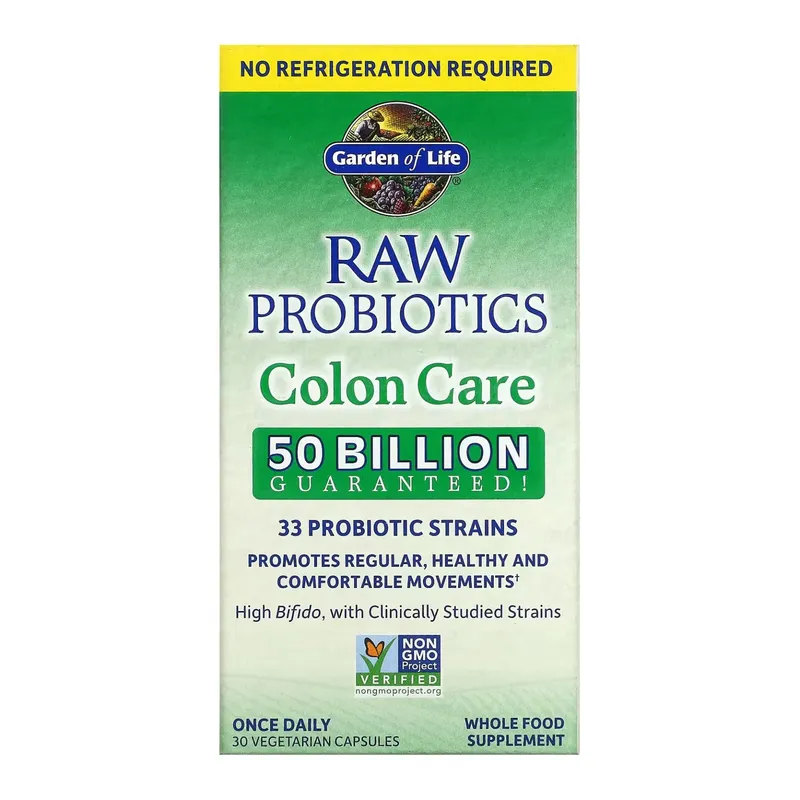
A 33-strain probiotic is not better than a 12-strain probiotic by default, because the strongest guideline recommendations name a single strain or a small, fixed set. A multi-strain product such as Garden of Life RAW Probiotics Colon Care, which lists 33 strains and 50 billion CFU per capsule, can still make sense if the strains you want are inside, and named. My rule: count the strains with codes, not the strains.
Who should not take probiotics without asking a doctor?
Probiotics are generally well tolerated by healthy adults, and they are not safe by default for everyone. The NIH Office of Dietary Supplements warns that probiotics might cause severe illness in people who are very ill or have immune system problems, and might cause infections in preterm infants. S. boulardii deserves its own caution: the CDC journal Emerging Infectious Diseases reported in 2021 on fungemia linked to S. boulardii supplements, and the European Medicines Agency reinforced a warning in 2017 against giving it to critically ill or immunocompromised patients. A central line, chemotherapy, a transplant, or pregnancy all mean ask first. If several bottles already share your counter, our guide to which vitamins and supplements should not be taken together covers the timing basics.
Four questions to ask before you buy a probiotic
- Are the strains coded? Genus, species, and a code like GG or Bl-04. No code, no evidence.
- Is the CFU guaranteed through expiration? “At time of manufacture” is a weaker promise.
- Does the strain match your reason? Antibiotic diarrhea has evidence. Vague “gut balance” does not.
- Are you in a caution group? Seriously ill, immunocompromised, or caring for a preterm infant: talk to a doctor first.
Frequently asked questions
Do probiotics need to be refrigerated?
Follow the storage line on your label, since CFU counts decline over time and storage sets the pace. Garden of Life states its 30 Billion and RAW Colon Care formulas are shelf-stable; Renew Life says refrigeration is recommended but not required for Extra Care 50 Billion.
Should I take a probiotic with food or on an empty stomach?
Take it the way the label directs, because the manufacturer built the capsule around that timing and the human data on meal timing is thin. If you fast in the mornings, our guide to supplements while fasting covers what does and does not break a fast.
Is a women’s probiotic different from a regular one?
A women’s probiotic is judged by the same rule: named strains with codes and a CFU guaranteed through expiration. The formulas in our women’s health section list their strains on the label, so read that list before the front-of-pack claims.
How long until a probiotic does anything?
For antibiotic-associated diarrhea, the NIH Office of Dietary Supplements ties the benefit to starting within two days of the first antibiotic dose. For general daily use there is no guideline timeline. My honest take: give one product four weeks, and if nothing has changed, stop paying for it.
Probiotics are only half of the gut conversation, because the bacteria also need something to eat, and fiber is that food. If you are weighing psyllium against inulin or wondering why a “prebiotic” powder made you bloated, our fiber supplements comparison sorts the four common types by gel, gas and best use.